
Now this is music to throw molotov cocktails to!!!!!!!
Lyrics:
Chaos A.D.
Tanks on the streets
Confronting police
Bleeding the plebs
Raging crowd
Burning cars
Bloodshed stars
Wholl be alive?!
Chaos A.D.
Army in siege
Total alarm
Im sick of this
Inside the state
War is created
No mans land
What is this shit?!
Refuse/Resist
Refuse
[Solo]
Chaos A.D.
Disorder unleashed
Starting to burn
Starting to lynch
Silence means death
Stand on your feet
Inner fear
Your worst enemy
Refuse/Resist
Refuse/Resist...
From their Chaos A.D album (1994)
Tuesday, March 4, 2008

Saturday, February 9, 2008
'Roger & Me' - 'Doco' by Michael Moore (1988)
The G.M C.E.O chase is on in true 'Moore' fashion, his mission, a few answers and maybe a bit of interrorgation. Looks like he'll have to look beyond his multi million dollar estate,the yacht or golf club!
General motors did a damn fine job of creating this apocalyptic landscape for the camera to document and Michael does a fine job of showing the bleakness and giving the viewer an insight of the people's painful predicament.
Wednesday, February 6, 2008
Why Socialism?

Why Socialism?
by Albert Einstein
This essay was originally published in the first issue of Monthly Review (May 1949).
Is it advisable for one who is not an expert on economic and social issues to express views on the subject of socialism? I believe for a number of reasons that it is.
Let us first consider the question from the point of view of scientific knowledge. It might appear that there are no essential methodological differences between astronomy and economics: scientists in both fields attempt to discover laws of general acceptability for a circumscribed group of phenomena in order to make the interconnection of these phenomena as clearly understandable as possible. But in reality such methodological differences do exist. The discovery of general laws in the field of economics is made difficult by the circumstance that observed economic phenomena are often affected by many factors which are very hard to evaluate separately. In addition, the experience which has accumulated since the beginning of the so-called civilized period of human history has—as is well known—been largely influenced and limited by causes which are by no means exclusively economic in nature. For example, most of the major states of history owed their existence to conquest. The conquering peoples established themselves, legally and economically, as the privileged class of the conquered country. They seized for themselves a monopoly of the land ownership and appointed a priesthood from among their own ranks. The priests, in control of education, made the class division of society into a permanent institution and created a system of values by which the people were thenceforth, to a large extent unconsciously, guided in their social behavior.
But historic tradition is, so to speak, of yesterday; nowhere have we really overcome what Thorstein Veblen called "the predatory phase" of human development. The observable economic facts belong to that phase and even such laws as we can derive from them are not applicable to other phases. Since the real purpose of socialism is precisely to overcome and advance beyond the predatory phase of human development, economic science in its present state can throw little light on the socialist society of the future.
Second, socialism is directed towards a social-ethical end. Science, however, cannot create ends and, even less, instill them in human beings; science, at most, can supply the means by which to attain certain ends. But the ends themselves are conceived by personalities with lofty ethical ideals and—if these ends are not stillborn, but vital and vigorous—are adopted and carried forward by those many human beings who, half unconsciously, determine the slow evolution of society.
For these reasons, we should be on our guard not to overestimate science and scientific methods when it is a question of human problems; and we should not assume that experts are the only ones who have a right to express themselves on questions affecting the organization of society.
Innumerable voices have been asserting for some time now that human society is passing through a crisis, that its stability has been gravely shattered. It is characteristic of such a situation that individuals feel indifferent or even hostile toward the group, small or large, to which they belong. In order to illustrate my meaning, let me record here a personal experience. I recently discussed with an intelligent and well-disposed man the threat of another war, which in my opinion would seriously endanger the existence of mankind, and I remarked that only a supra-national organization would offer protection from that danger. Thereupon my visitor, very calmly and coolly, said to me: "Why are you so deeply opposed to the disappearance of the human race?"
I am sure that as little as a century ago no one would have so lightly made a statement of this kind. It is the statement of a man who has striven in vain to attain an equilibrium within himself and has more or less lost hope of succeeding. It is the expression of a painful solitude and isolation from which so many people are suffering in these days. What is the cause? Is there a way out?
It is easy to raise such questions, but difficult to answer them with any degree of assurance. I must try, however, as best I can, although I am very conscious of the fact that our feelings and strivings are often contradictory and obscure and that they cannot be expressed in easy and simple formulas.
Man is, at one and the same time, a solitary being and a social being. As a solitary being, he attempts to protect his own existence and that of those who are closest to him, to satisfy his personal desires, and to develop his innate abilities. As a social being, he seeks to gain the recognition and affection of his fellow human beings, to share in their pleasures, to comfort them in their sorrows, and to improve their conditions of life. Only the existence of these varied, frequently conflicting, strivings accounts for the special character of a man, and their specific combination determines the extent to which an individual can achieve an inner equilibrium and can contribute to the well-being of society. It is quite possible that the relative strength of these two drives is, in the main, fixed by inheritance. But the personality that finally emerges is largely formed by the environment in which a man happens to find himself during his development, by the structure of the society in which he grows up, by the tradition of that society, and by its appraisal of particular types of behavior. The abstract concept "society" means to the individual human being the sum total of his direct and indirect relations to his contemporaries and to all the people of earlier generations. The individual is able to think, feel, strive, and work by himself; but he depends so much upon society—in his physical, intellectual, and emotional existence—that it is impossible to think of him, or to understand him, outside the framework of society. It is "society" which provides man with food, clothing, a home, the tools of work, language, the forms of thought, and most of the content of thought; his life is made possible through the labor and the accomplishments of the many millions past and present who are all hidden behind the small word “society.”
It is evident, therefore, that the dependence of the individual upon society is a fact of nature which cannot be abolished—just as in the case of ants and bees. However, while the whole life process of ants and bees is fixed down to the smallest detail by rigid, hereditary instincts, the social pattern and interrelationships of human beings are very variable and susceptible to change. Memory, the capacity to make new combinations, the gift of oral communication have made possible developments among human being which are not dictated by biological necessities. Such developments manifest themselves in traditions, institutions, and organizations; in literature; in scientific and engineering accomplishments; in works of art. This explains how it happens that, in a certain sense, man can influence his life through his own conduct, and that in this process conscious thinking and wanting can play a part.
Man acquires at birth, through heredity, a biological constitution which we must consider fixed and unalterable, including the natural urges which are characteristic of the human species. In addition, during his lifetime, he acquires a cultural constitution which he adopts from society through communication and through many other types of influences. It is this cultural constitution which, with the passage of time, is subject to change and which determines to a very large extent the relationship between the individual and society. Modern anthropology has taught us, through comparative investigation of so-called primitive cultures, that the social behavior of human beings may differ greatly, depending upon prevailing cultural patterns and the types of organization which predominate in society. It is on this that those who are striving to improve the lot of man may ground their hopes: human beings are not condemned, because of their biological constitution, to annihilate each other or to be at the mercy of a cruel, self-inflicted fate.
If we ask ourselves how the structure of society and the cultural attitude of man should be changed in order to make human life as satisfying as possible, we should constantly be conscious of the fact that there are certain conditions which we are unable to modify. As mentioned before, the biological nature of man is, for all practical purposes, not subject to change. Furthermore, technological and demographic developments of the last few centuries have created conditions which are here to stay. In relatively densely settled populations with the goods which are indispensable to their continued existence, an extreme division of labor and a highly-centralized productive apparatus are absolutely necessary. The time—which, looking back, seems so idyllic—is gone forever when individuals or relatively small groups could be completely self-sufficient. It is only a slight exaggeration to say that mankind constitutes even now a planetary community of production and consumption.
I have now reached the point where I may indicate briefly what to me constitutes the essence of the crisis of our time. It concerns the relationship of the individual to society. The individual has become more conscious than ever of his dependence upon society. But he does not experience this dependence as a positive asset, as an organic tie, as a protective force, but rather as a threat to his natural rights, or even to his economic existence. Moreover, his position in society is such that the egotistical drives of his make-up are constantly being accentuated, while his social drives, which are by nature weaker, progressively deteriorate. All human beings, whatever their position in society, are suffering from this process of deterioration. Unknowingly prisoners of their own egotism, they feel insecure, lonely, and deprived of the naive, simple, and unsophisticated enjoyment of life. Man can find meaning in life, short and perilous as it is, only through devoting himself to society.
The economic anarchy of capitalist society as it exists today is, in my opinion, the real source of the evil. We see before us a huge community of producers the members of which are unceasingly striving to deprive each other of the fruits of their collective labor—not by force, but on the whole in faithful compliance with legally established rules. In this respect, it is important to realize that the means of production—that is to say, the entire productive capacity that is needed for producing consumer goods as well as additional capital goods—may legally be, and for the most part are, the private property of individuals.
For the sake of simplicity, in the discussion that follows I shall call “workers” all those who do not share in the ownership of the means of production—although this does not quite correspond to the customary use of the term. The owner of the means of production is in a position to purchase the labor power of the worker. By using the means of production, the worker produces new goods which become the property of the capitalist. The essential point about this process is the relation between what the worker produces and what he is paid, both measured in terms of real value. Insofar as the labor contract is “free,” what the worker receives is determined not by the real value of the goods he produces, but by his minimum needs and by the capitalists' requirements for labor power in relation to the number of workers competing for jobs. It is important to understand that even in theory the payment of the worker is not determined by the value of his product.
Private capital tends to become concentrated in few hands, partly because of competition among the capitalists, and partly because technological development and the increasing division of labor encourage the formation of larger units of production at the expense of smaller ones. The result of these developments is an oligarchy of private capital the enormous power of which cannot be effectively checked even by a democratically organized political society. This is true since the members of legislative bodies are selected by political parties, largely financed or otherwise influenced by private capitalists who, for all practical purposes, separate the electorate from the legislature. The consequence is that the representatives of the people do not in fact sufficiently protect the interests of the underprivileged sections of the population. Moreover, under existing conditions, private capitalists inevitably control, directly or indirectly, the main sources of information (press, radio, education). It is thus extremely difficult, and indeed in most cases quite impossible, for the individual citizen to come to objective conclusions and to make intelligent use of his political rights.
The situation prevailing in an economy based on the private ownership of capital is thus characterized by two main principles: first, means of production (capital) are privately owned and the owners dispose of them as they see fit; second, the labor contract is free. Of course, there is no such thing as a pure capitalist society in this sense. In particular, it should be noted that the workers, through long and bitter political struggles, have succeeded in securing a somewhat improved form of the “free labor contract” for certain categories of workers. But taken as a whole, the present day economy does not differ much from “pure” capitalism.
Production is carried on for profit, not for use. There is no provision that all those able and willing to work will always be in a position to find employment; an “army of unemployed” almost always exists. The worker is constantly in fear of losing his job. Since unemployed and poorly paid workers do not provide a profitable market, the production of consumers' goods is restricted, and great hardship is the consequence. Technological progress frequently results in more unemployment rather than in an easing of the burden of work for all. The profit motive, in conjunction with competition among capitalists, is responsible for an instability in the accumulation and utilization of capital which leads to increasingly severe depressions. Unlimited competition leads to a huge waste of labor, and to that crippling of the social consciousness of individuals which I mentioned before.
This crippling of individuals I consider the worst evil of capitalism. Our whole educational system suffers from this evil. An exaggerated competitive attitude is inculcated into the student, who is trained to worship acquisitive success as a preparation for his future career.
I am convinced there is only one way to eliminate these grave evils, namely through the establishment of a socialist economy, accompanied by an educational system which would be oriented toward social goals. In such an economy, the means of production are owned by society itself and are utilized in a planned fashion. A planned economy, which adjusts production to the needs of the community, would distribute the work to be done among all those able to work and would guarantee a livelihood to every man, woman, and child. The education of the individual, in addition to promoting his own innate abilities, would attempt to develop in him a sense of responsibility for his fellow men in place of the glorification of power and success in our present society.
Nevertheless, it is necessary to remember that a planned economy is not yet socialism. A planned economy as such may be accompanied by the complete enslavement of the individual. The achievement of socialism requires the solution of some extremely difficult socio-political problems: how is it possible, in view of the far-reaching centralization of political and economic power, to prevent bureaucracy from becoming all-powerful and overweening? How can the rights of the individual be protected and therewith a democratic counterweight to the power of bureaucracy be assured?
Clarity about the aims and problems of socialism is of greatest significance in our age of transition. Since, under present circumstances, free and unhindered discussion of these problems has come under a powerful taboo, I consider the foundation of this magazine to be an important public service.

Monday, February 4, 2008
Music Video: FIGHT THE POWER - Public Enemy (1989)
I wanted to provide the full length clip to this song with the awsome opening of 1960's footage of African American civil rights protests, but the copyright owners for some fucking reason have decided they prefer restricted access to this version. Im not entirely sure why this is, but they still allow the shortened version to be embedded in blogs! (WTF!!) Anyway, here it is, one of the greatest anti establishment songs of all time, FIGHT THE POWER by PUBLIC ENEMY!!! If you have never really listened to the lyrics of this song, now is your chance. Kick back, tune in, drop out ;-) These guys are so tuned in to societal control & unfair repressive laws, totally blows my mind!
Tuesday, January 29, 2008
Music Video: "Ministry: Lieslieslies"
With the turmoil of our western democratic system, industrial metal legends "Ministry" have come forth with a smack in the face of George W with their politically charged (and appropriately titled ) "Lieslieslies" track, from the 2006 release "Rio Grande Blood".
This is their second most current release and some of their most political work to date. Their latest on the other hand, "The Last Sucker", continues this deeply political vibe, with an even more pissed off sound! It is said to be Ministry's last album of original material by founding member Al Jourgensen, sighting that 20 + years the band has run its course. I digress a little. Just enjoy the track and feel the anger.
This is their second most current release and some of their most political work to date. Their latest on the other hand, "The Last Sucker", continues this deeply political vibe, with an even more pissed off sound! It is said to be Ministry's last album of original material by founding member Al Jourgensen, sighting that 20 + years the band has run its course. I digress a little. Just enjoy the track and feel the anger.
*Extra: Lyrics added below clip. Words of beauty arn't they!
(Stay tuned for a full review of the album coming soon!).
Saturday, January 19, 2008
The control of an under educated population in a tyrinical media manipulated society!
Want access to the truth of our world?
It involves our own societies, our families, our friends and Countrymen. We are having the the facts manipulated and darkness pulled over our eyes! Corporation & governments (often one & the same) are trying and succeeding to control the populus with mindless propaganda entertainment (TV, commercial radio, movies, newspaper), the B.S war on terror, ID cards that track your every move! Be informed!! Wake up to reality!
The corruption of governments, needless loss of human life through greed / war, manipulation of facts by governments, fact falsifying media barons who own majority media publications (inc' television news broardcasters) & blatent destruction of human civil liberties is TRUE horror in every sense of the word!!
This doco will blow your mind and shatter your perception of our world!
It seems too insane to be fact, but these guys put forward a stunningly convincing argument!
Be warned, once absorbed there is no turning back!
(Part 1)
(Part 2)
(Part 3)
(Part 4)
(Part 5 of 5)
It involves our own societies, our families, our friends and Countrymen. We are having the the facts manipulated and darkness pulled over our eyes! Corporation & governments (often one & the same) are trying and succeeding to control the populus with mindless propaganda entertainment (TV, commercial radio, movies, newspaper), the B.S war on terror, ID cards that track your every move! Be informed!! Wake up to reality!
The corruption of governments, needless loss of human life through greed / war, manipulation of facts by governments, fact falsifying media barons who own majority media publications (inc' television news broardcasters) & blatent destruction of human civil liberties is TRUE horror in every sense of the word!!
This doco will blow your mind and shatter your perception of our world!
It seems too insane to be fact, but these guys put forward a stunningly convincing argument!
Be warned, once absorbed there is no turning back!
Media: "Zeitgeist" (Part 1) "Federal Reserve" (In 5 parts).
Never understood why we have such turmoil in economies?
Financial markets soar like a bird then plummet like a stone, just when everybody is living prosperously?
Now you will!
This is truly astounding information on how the Federal Reserve Bank controls (& has controlled) governments, society and war!
It is taken from part 3 of the Documentary "Zeitgeist", but I have made this the first posting as I feel it is the most shocking of all!
(Part 1 & 2 from the movie to come!!)
Financial markets soar like a bird then plummet like a stone, just when everybody is living prosperously?
Now you will!
This is truly astounding information on how the Federal Reserve Bank controls (& has controlled) governments, society and war!
It is taken from part 3 of the Documentary "Zeitgeist", but I have made this the first posting as I feel it is the most shocking of all!
(Part 1 & 2 from the movie to come!!)
(Part 1)
(Part 2)
(Part 3)
(Part 4)
(Part 5 of 5)
Thursday, January 17, 2008
Redundant Posts Below!
FROM THIS POST DOWN IS THE REDUNDANT CONTENT OF THE OLD BLOG. "RISE AGAINST (TYRANNY) " WAS FORMERLY NAMED: "DEAD SPEAK" & WAS ONCE A BLOG ABOUT HEAVY METAL & CLASSIC HORROR FILMS! FEELING THAT THIS WAS AN EMPTY EXERCISE, I HAVE RETIRED THE FORMAT OF OLD AND AM NOW GOING FORTH WITH A WORTHY CAUSE! THESE CLASSIC(?) POSTS WILL REMAIN HERE FOR PROSPERATIES SAKE & BECAUSE I CANT BRING MYSELF TO DELETE THEM YET! WHEN I GROW TIRED OF THEM THEY WILL BE DELETED. PROCEED IF YOUR INTERESTED, OTHERWISE CHECK BACK FOR MORE FROM "RISE AGAINST" SOON!
REGARDS - CYBERWASTED.
REGARDS - CYBERWASTED.
Music Review: The Amenta - Occasus (2004)
Ferocious primeval Death metal played with explosive blast beats, threateningly fast tempo-ed guitars, dominantly powerful raspy vocals and ambient synth elements lay in wait for the listener of the 2004 release "Occasus" from the band "The Amenta".
A highly innovative follow up to their acclamied Demo of 2002 "Mictlan", The Amenta play with crushing efficiency paving a new force in extreme music. Influenced, but far from a clone of any previous band, The Amenta have inclinations of death, black, industrial, thrash metal embodied in their brand of powerful chaotic intensity. For all its extremity, The Amenta know how to slam the breaks on just at the appropriate moment to provide the listener with beautiful sound scapes of syth ambience before again jumping into a whirl wind of perfectly balanced brutality. This synth ambience too plays a prominent part in the bare bones structure of their raw music tracks, enhancing an already masterful music and helping the band forge their exquised sounds.
Production wise the recording is solid with a perfect balancing between vocals and instrumentation.
This is a surprisingly strong release that is a damn shame has barely made a ripple in the music scene. Hailing from South Australia would certainly have played a part in this, for if The Amenta came from the USA or Europe, they would most certainly be highly promoted and playing with the biggest names of the metal world by now. Lets hope the rest of the metal fraternaty realise what a masterful work the band has delivered with the “Occasus” before it sinks between the dark cracks into metal obscurity.
(Recently re: released as a Limited Ed' 2 Disc jam packed with bonus tracks, interviews, video clips, photos and extra art work!)
Video Clip: " The Amenta: Erebus" (Occasus, 2004).
Tuesday, January 15, 2008
REDUNDANT CONTENT.
Film Review: Night Creatures (1965)
In a word, spectacular! One of Hammer Studio's finest works is delivered in the form of Night Creatures a.k.a Captain Clegg. Part adventure, part drama, part thriller and with a smattering of syilized horror, Night Creatures is one big dose of fun!
A terrifying buccaneer adventure involving smuggling across 18th century English Marshes by celebrated pirate, Captain Clegg and his men. The dastardly villain disguises himself as the quaint village clergyman of 'Dymchurch', "Doctor Blyss", whilst carrying out his pirate activities under the alias of Captain Clegg. Clegg’s henchmen, dubbed the ‘Marsh Phantoms’; are extremely efficient at scaring off the locals, disguising a look-out as a scarecrow, transferring contraband alcohol in hearses, and generally sending the town's populus into disarray. Hot on their trail is Captain Collier, the English officer set with the assignment of exposing the gang and bringing them down. His suspicions initially aroused by a mute seemingly tormented by a face from his past. (Note: While the plot proved to be a fraction transparent initially, this hiccup is soon but a faded memory thanks to outstanding production values and gripping story).
The legendary Peter Cushing shines in one of his greatest and most charming roles playing "Dr Blyss", an absolute delight to watch and impeccable in his delivery of character. He is for lack of a better word, flawless. The support comes from an almost as brilliant cast including: Patrick Allan as the obcessed ruthless "Captain Collier", Oliver Reed as "Harry" the "Squires" son, Derrick Francis as the "Squire" and the divine Yvonne Romain as "Imogene", the young orphaned bar maid. Additional characters of note include a mute earless "Fedrret", a King's battalion and the ghostly horsemen.
With a setting of 1700's England, Captain Clegg is craftily shot and had me firmy planted in a totally believable world. Atmospherics as can be expected with any quality "Hammer" production, are exceptional and the film delivers the goods with its gothic church, creepy graveyard, rustic tavern, victorian architecture and fog laden marshes.
If your a fan of Hammer studios, or just after a quality well produced wild ride, Night Creatures is an absolute must see!
Links to:
Unofficial "Hammer" Site (More fun than the original!)
Hammer Filmography (Whilst comprehensive, this is a free hosted site, apologies if the link is dead!)
Official Hammer Films Site.
Wednesday, November 21, 2007
Subliminal Messages

A brief "insightful" look at the hidden dirty tactics often utilised by advertisers (and even heavy metal musicians) that deceive and brain wash the public, all in the name of profits. (Warning: Not for the Faint of heart!) *Click here to launch*.
Wednesday, November 7, 2007
Book Review: "Creed" by James Herbert

This is my first foray into a world created by Herbert and like a sweaty trembling decaying toothed crack addict, I am hooked. I picked this book up for 50 cents from a bargain rack at the local hospital where I work with no inkling what was instore other than the depiction of a rather demonic looking screaming scull on the cover. Below the standard gold lettering stamping the authors name and the book title was a little quote from the Daily Mail "Turbo Charged and spewing black fumes", I just had to have it!
"Sometimes horror is in the mind. And sometimes it's real. Telling the difference isn't always easy. It wasn't for Joe Creed. He'd just photographed the unreal, and now he had to pay the price. Because he thought demons were just a joke, but the jokes on him" (From "Creed").
James Herbert is one amazingly twisted genius. From the first page through to the very last word, this was a book I found extremely hard to put down. I used to think that finishing a novel in 48hrs was crap and anyone who says they've done it is full of it. Well thats exactly how long this novel took me, I was glued to my seat, if I put it down I couldn't stop thinking about it and when I wasn't reading it I felt as though I had legitamite withdrawal symptoms. The story invaded my very life and took me one one hell of a wild edge of my seat ride.
The book takes place in London with a plethra of richly detailed characters from the lead Creed, a Paparazzi photograper who meets all matter of people and demons aplenty. Demons taking on the appearance of a seductress, a strapping gentlman or the classic, "Herbertized" fear paralyzing version. The type that keep to the shaddows, have spider like legs, speed of a jaguar and stink of rotting meat!
I can't recommend this book enough. If your a horror fan this yarn is a must. But be warned, it is an unstoppable cracking feast of gore, debauchery, insanity, terror, passion and the blackest of black humor that once started will leave your head spinning and your life effected.
Links to:
A Quality "James Herbert" Website.
Interview with "James Herbert" (.MP3)
A day in the life with Horror Legend Bruce Campbell
Evil Dead's Ash talks out about the horrors of making sequels, fake blood, and living in the wilds of Oregon A recent insightful peak into Bruce Campbell's thoughts about life and his role in the making of some the greatest cult horror films.
Monday, November 5, 2007
Music Review: Daath - The Hinderers (2007)

Their first release after inking a deal with the cultish label Road Runner Records, Daath are bursting with melody, blast beats, precision riffs, spine tingling solos, and vocals that shred the delicate little hairs inside your ears to stubs. Metal fans of the world rejoyce, Daath have arrived to pulverise, enslave and dominate our scene, and arn't we elated that our humble lives will never again be the same!
Forging ahead with an eclectic evolving sound, the six piece from the U.S.A's Atlanta, Georgia, have created one of the most intense but melody focused death metal releases I've had the pleasure of listening to for quite some time. Infused with industrial / synth sounds throughout the tracks, The Hinderers manages to elevate the band head and shoulders above the many of their contemoraries.
Three of their many stand out tracks include the all round super catchy Subterfuge with its angelic guitar melody splices & intermittent blast beats, the synth heavy mid paced Under a sobre sign with its piano / synth intro and finally the album is drawn to a close with the masterful doom inspired slow grind of Blessed through misery.
Unfortunately the Hinderers is not entirely without its flaws. Despite the powerful opening of Subterfuge, the band quickly follows this with two uninspired generic "metal by numbers" tracks. With them aside, most of the remainder of the album thankfully manages to propel the release ever faster onto metal legendary status. Occassionally too, Daath skims very close to the tried and tested sounds of their forbears sceaming Opeth, In Flames, even U.S (relative) new commers Devil Driver, but, there is still enough music diversity to bring a big juicy stamp of their own originality to the scene.
Production wise The Hinderers is impecable with a crystal clear near perfect balance of the instrumentation and vocals, nothing less than we have come to expect from Road Runner Records.
In conclusion The Hinderers is a very exciting release from Daath which should firmly place the band on the world metal map. If you haven't picked up a copy you are absolutely missing out on one of the most refreshing, melodic listenable heavy metal albums of 2007. Never the less, if the metal gods are truly listening, this is an album which will be around for some time yet casting its shaddow :) across our lands for all to bathe in its distorted aural pleasures!
The Clip for "Daath - Subterfuge"
Sunday, November 4, 2007
Film Review: Creep (2005)

A chase film with a difference! Creep is the debut feature length directorial by little known Englishman Christopher Smith. (Fast becoming a horror heavy weight thanks to his second offering Severence) (2006).
The film tells the story of Kate, a young career driven woman whom after attending a party heads to the underground in an attempt to catch the last train of the evening to meet up with a friend. Being slightly intoxicated Kate shuts her eyes for a quick rest while waiting on the train platform and soon awakens to find the station devoid of people, trains and adding insult, all exits have been locked for the night. And so begins her saga, an invain attempt to raise knowledge of her incarceration to the outside world. What Kate doesn't yet know is that she is far from alone, for amongst the labarynth of dark train tunnels and empty sterile neon light corridors and stations, there is a sinister presence lurking with an insatiable urge.
Saturday, November 3, 2007
Classic Music Review: Fear Factory - Demanufacture

Demanufacture is an old album by any standard, being released way back before the turn of the century in 1995. Despite its ripe old age, this is definately no fermenting aging release, sounding absolutely as fresh today and as poignant as ever. This is Fear Factory's absolute must have. It is best described as a concept album of fast technical "cybermetal" (industrial infused thrash / speed metal) with lyrics inspired by mans symbiosis with the machine and enduring of a dystopian society. Grinding distorted guitars, plenty of double kick drumming in time with the lead guitarist's strumming / plucking, alternating raspy & harmonising singing & frequent electronic samples are all served piping hot in a big fat serving just right for auditory ingestion.
Years ahead of their time and absolute pioneers of the modern metal scene. They haven't become one of my downright favourite bands for no reason. This is the album that started it all for me and put Fear Factory on the metal map as a force to be reckoned with, let it do the same for you.
*WARNING*: Hell is full & the dead are walking!!
?%
Would you survive the ravenous cravings of the living
dead legions if hell was full? Take the online no
strings attached (i.e. THAT'S FUN PEOPLE!!) test
& find out!
Film Review: Horror Express (1972)

This is horror cinema!
Horror Express is easily one of my all time favourite classic horror films. It has all the hallmarks of greatness. Firstly it stars 2 supremo horror actors, the late great Mr Peter Cushing and the equally brilliant Mr Christopher Lee. Secondly it has a story to die for including, a alien entity that is bought aboard the the Express train frozen in a "missing link" monster. (But frozen not for long!) An evil being that drains the memories of the living through simply staring and hypnotizing its prey, turning them into white eyed corpses. Mouth watering creature and camera effects, man this is one creepy entity. A finale that includes a horde of undead zombies amassing towards a trapped group of passengers on a speeding coal fired locamotive. And much, much more. Oh and lest we forget a strong supporting cast including Telly Savalas. Horror Express quite simply has some of the most memorable and genuinely chilling scenes and imagry of any horror film, period. An absolute horror classic. Don't miss this gem. I've seen it no less than 5 times since I first discovered it a few years back and it never ceases to feel fresh or pack the same powerful punch as the first viewing. This is a very rare feat.
Film Review: POSSESSION (1981)
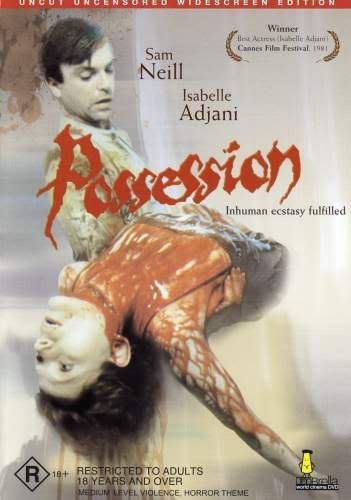
A dream, a nightmare, or an insight into the dark recesses of the writers subconsciousness?
Possession is avant garde film noir that truly has to be seen to be appreciated or believed. Set with a backdrop of Berlin Germany (wall and all) in 1981, Sam Neill plays an increasingly tormented husband who's dear wife (Andrzej Zulawski) is becoming progressively bleak, with her bitterness of him escilating as her self loathing intensifies. Insidiously, she retreats to a world of despair and increasing erratic maddness which ultimately results in an aggressive marital seperation. At a loss and fast becoming a psychological & physical wreck, he follows his love and soon discovers she is fornicating with a black tenticled malevolent entity and has embarked on a murderous rampage, killing those that intrude on her nest. Is she acting of her own free will, a slave to her urges or are there more sinister forces at play? What is this being that has such a grip on her?
Immensely entertaining dark and often nasty but poetic through out, Possession feels like no other film I've ever seen. It is beautifully filmed with often odd seductive angles, supurbly acted, near masterful work of art which only falls down due to its extensive length and at times sluggish pacing. This is a film that is burned into your brain long after viewing and is as much an experience of the senses as a piece of celluloid entertainment. Sam Neill is brilliant in the lead role and Andrzej Zulawski is equally so.
Subscribe to:
Posts (Atom)


